
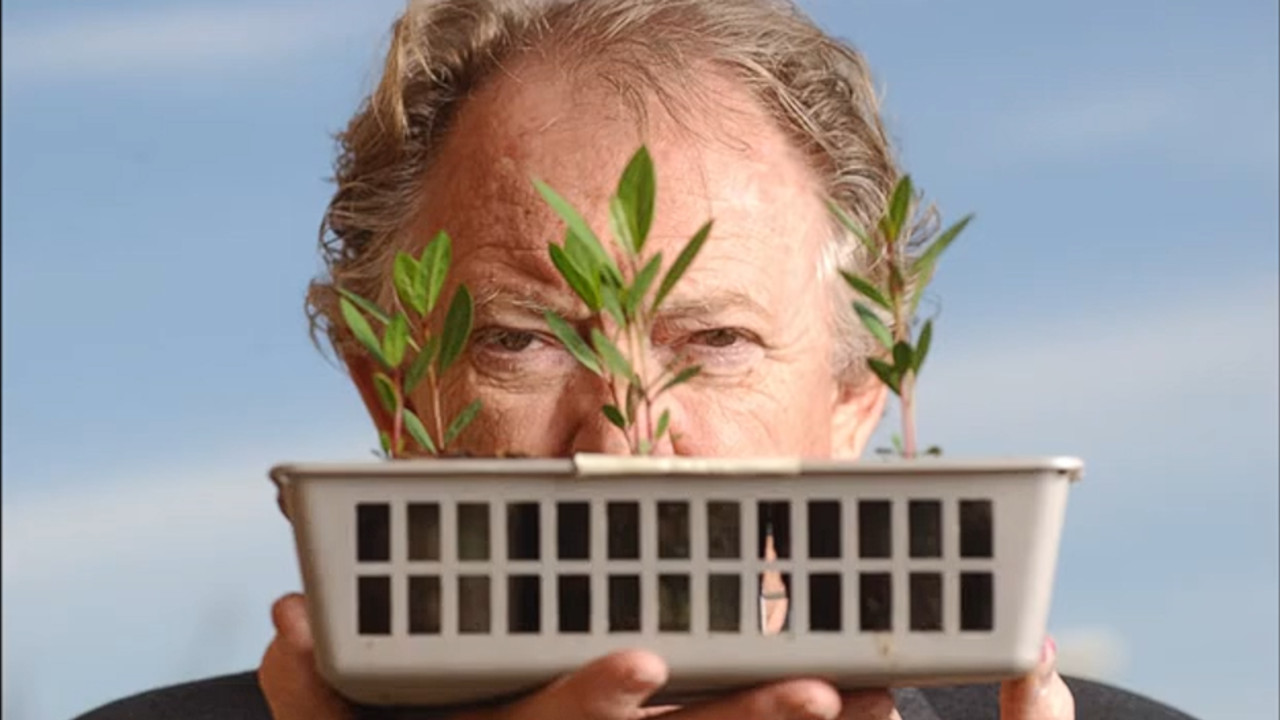
Editor’s note: To accompany this section of the book, we have found a video introducing Dr Karl Hodges, which is available below:
Chapter 2: The Desert Lung – Dr. Carl Hodges and the Mirage of the Gulf
If the PEI Ark was a counter-culture dream born in the mud of the Maritimes, the projects of the Environmental Research Laboratory (ERL) at the University of Arizona were their high-octane, industrial cousins. By the late 1970s, the “biological metabolism” discovered by Todd was being courted by the wealthiest kingdoms on Earth. The monarchs of the Gulf—specifically in Abu Dhabi and Saudi Arabia—were looking at their vast, sun-scorched coastlines and asking a question of survival: Can we buy our way out of hunger?
Into this arena stepped Dr. Carl Hodges. A man of towering technical optimism and fearless ambition, Hodges didn’t just want to build a greenhouse; he wanted to build a “Power-Water-Food” Nexus. He looked at the desert not as a wasteland, but as a high-energy laboratory where the sun was the ultimate resource, if only it could be tamed.
 The Engineering of an Oasis
Hodges’ strategy, as Director of the ERL, was the peak of post-Apollo engineering. He proposed a massive, integrated system that felt like something out of science fiction. The logic was a straight line of industrial efficiency:
- The Energy Loop: Use large diesel generators to provide electricity for the kingdom.
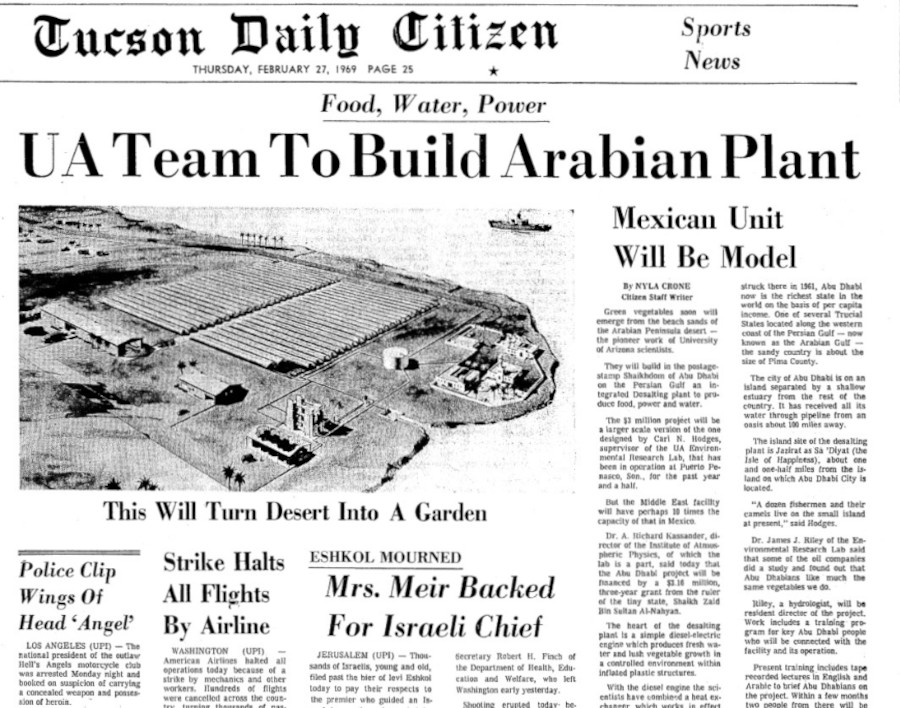
- The Water Loop: Use the “waste heat” from those generators to desalinate seawater through a process called “waste-heat desalinization.”
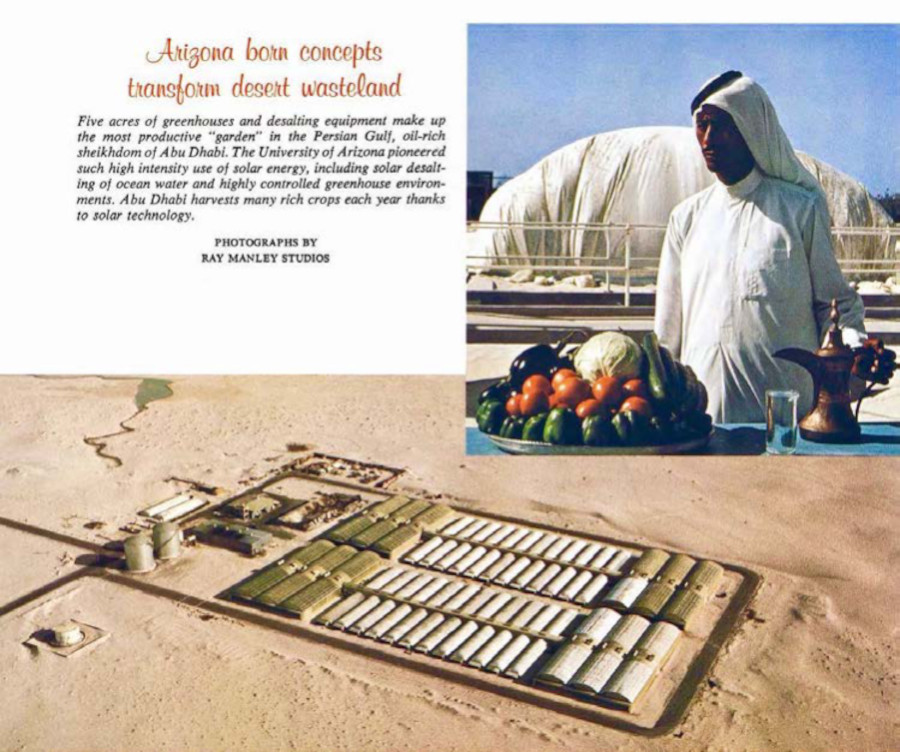
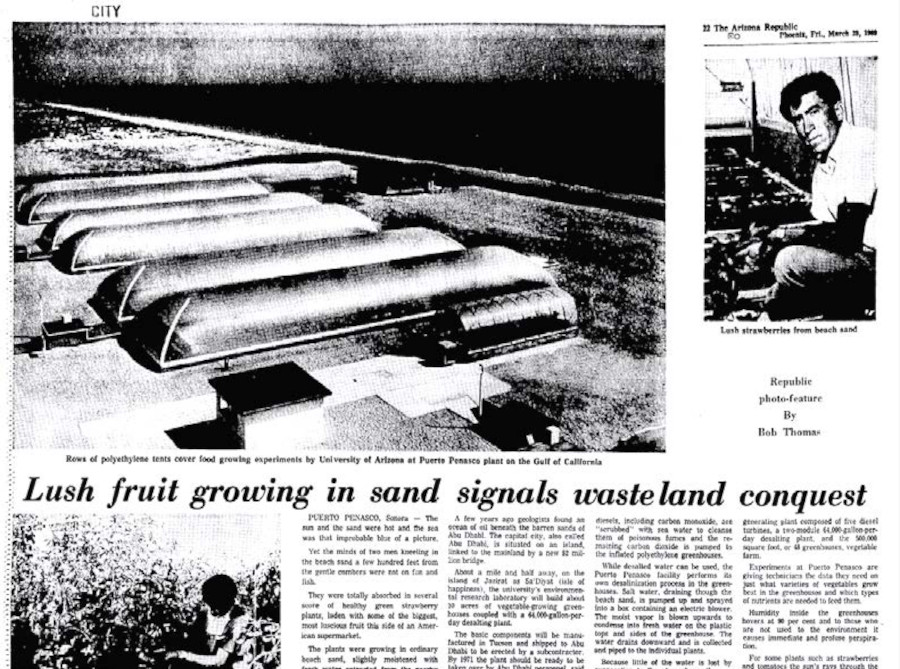
- The Food Loop: Take that fresh water and pump it into hectares of sophisticated glass and plastic structures to grow vegetables in the middle of the dunes.
The crown jewel of this effort was the Sadiyat Island project in Abu Dhabi. For the first time, researchers were proving that they could grow high-value crops—cucumbers, tomatoes, and peppers—in a place where nothing had grown for millennia. Hodges wasn’t just “farming”; he was mastering the environment. He was pushing the envelope of human knowledge, proving that with enough capital and engineering “grit,” the climate was no longer a cage.
The “Pad-and-Fan” Breakthrough
To survive the 50°C (122°F) desert heat, Hodges pioneered the Pad-and-Fan cooling system. This was the “Desert Lung.”
- The Physics: Massive fans at one end of the greenhouse drew hot, dry desert air through “pads” on the opposite wall that were kept constantly wet with water.
- The Magic: As the air passed through the wet pads, the physics of latent heat of evaporation took over. The water absorbed the heat from the air to evaporate, dropping the temperature inside the structure by as much as 20°C in a matter of seconds.
It worked. It was a technical triumph. It felt like a win for humanity. But as the projects scaled, Hodges and his team hit an Invisible Wall—a wall made of thermodynamic laws that no amount of oil wealth could climb over.
The Water Paradox: The Dehydration Engine
The investigative records of these Gulf projects reveal a heartbreaking realization. The very mechanism that kept the plants cool—the “Desert Lung”—was also the system’s greatest liability.
- The Exhalation: To keep the temperature stable, the fans had to run continuously during the never ending, long sunny days. The greenhouse was “breathing” at an incredible rate.
- The Loss: Because the outside air was so dry and the “insolation” so great, the plants inside were forced to transpire (sweat) at a furious pace to survive. The “Pad-and-Fan” system was effectively sucking the moisture out of the plants and blowing it into the desert sky.
- The “Leaky Bucket”: Hodges had created a “Dehydration Engine.” To grow a few kilograms of tomatoes, they were “exhaling” thousands of liters of precious, desalinated fresh water into the atmosphere.
The system was “Net-Negative.” It was a life-support system on an expensive, high-energy IV drip. If the diesel generators stopped, or if the water pumps failed for even an hour, the “Oasis” would be incinerated by the sun.
The Invisible Wall and the Tangible Consequence
Dr. Hodges and his team were “fearless pioneers” who found the Absolute Limit of Ventilation. They proved that you cannot “vent” your way to abundance in a hot climate. The more you cool a building by moving air, the more water you lose.
This resulted in the “Mothball Effect.” Across the Gulf, multimillion-dollar facilities that were once the pride of nations began to fall into disrepair. The cost of the “Water Tax” and the energy required to fight the environment became unsustainable. The kingdoms had bought the technology, but they hadn’t bought Resilience.
The Investigative Conclusion
Carl Hodges proved that we could grow food anywhere, but he also proved that our Building Anatomy was wrong. Like John Todd in PEI, Hodges was working with a “Static Shell.” He was trying to solve a dynamic, solar problem with fixed fans and open vents.
The story of the Desert Lung is the story of the second “marathon” leg. It taught us that Closure is the only path to Abundance. If we wanted to feed the world, we couldn’t have a building that “breathed out” its lifeblood. We needed a building that could stay cool while keeping its mouth shut—a Closed-Loop Condenser.
[… to be continued in the next post]